
Calibration of a weighing scale means testing it against certified reference weights and adjusting it so it reads correctly. It is how you prove that every kilogram you sell, buy or produce is a real kilogram. Scalestech's calibration laboratory is accredited by KENAS to ISO/IEC 17025, so our results are traceable to national and international standards. This guide explains how calibration works, how often you need it and how to read a calibration certificate.
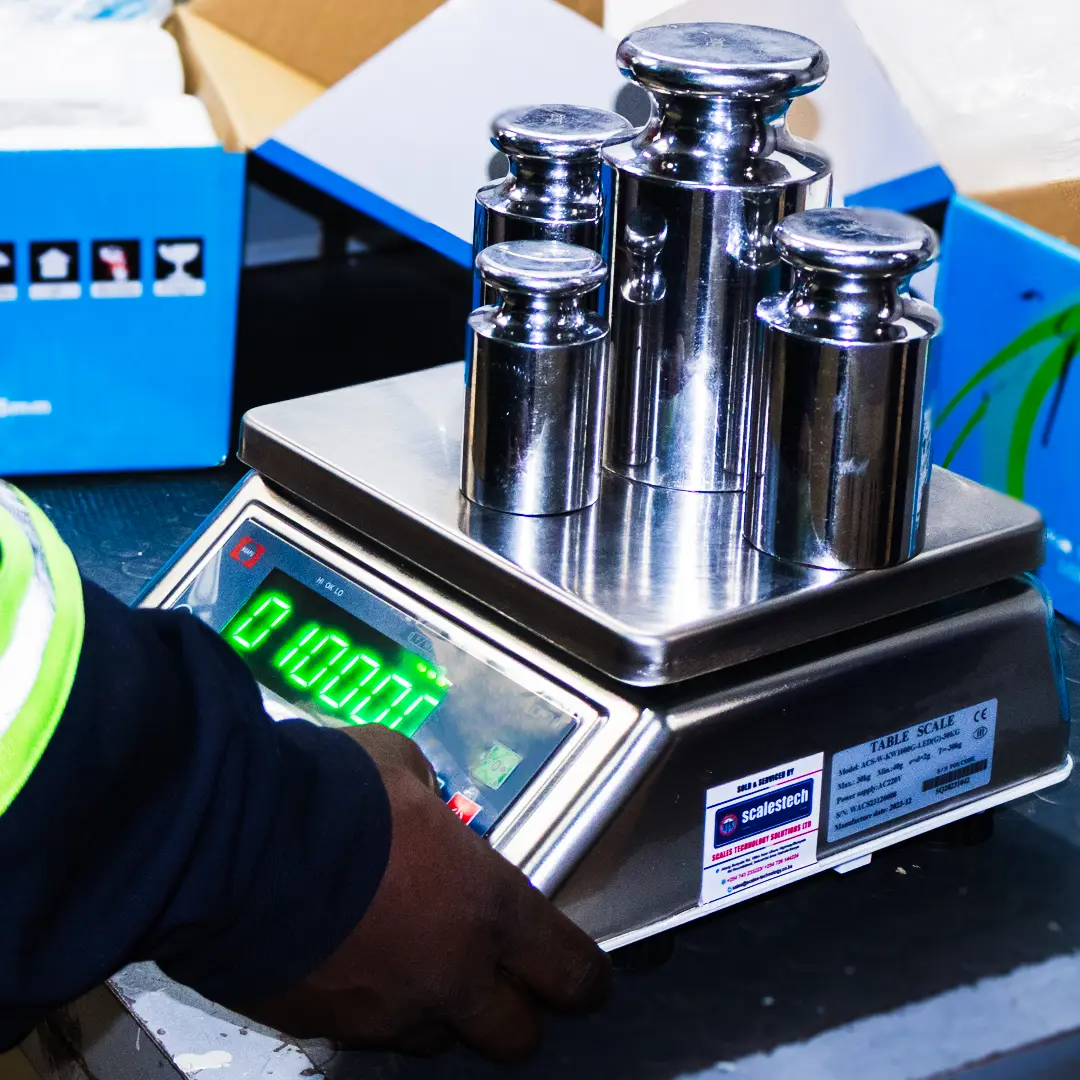
Why calibration matters
- Fair trade: customers get exactly what they pay for.
- Protected margins: no losses from giving away weight or overcharging.
- Quality and audits: food, pharmaceutical and manufacturing audits (ISO 9001, ISO 22000, GMP) expect calibrated equipment with records.
- Legal compliance: trade scales must stay within legal limits to pass Weights & Measures verification.
How a weighing scale is calibrated
- Inspection: the scale is checked for damage, levelled and warmed up.
- Zero and repeatability test: the same weight is placed several times to check the scale gives the same result.
- Eccentricity (corner) test: a weight is placed in each corner and the centre to check the reading does not change with position.
- Linearity test: certified weights are added in steps up to the scale's capacity and the error is recorded at each point.
- Adjustment: if errors are outside tolerance, the scale is adjusted and the tests repeated.
- Certificate: results, errors and measurement uncertainty are reported on a calibration certificate.
Large scales and weighbridges are calibrated on site with test weight sets and, where needed, build-up methods.
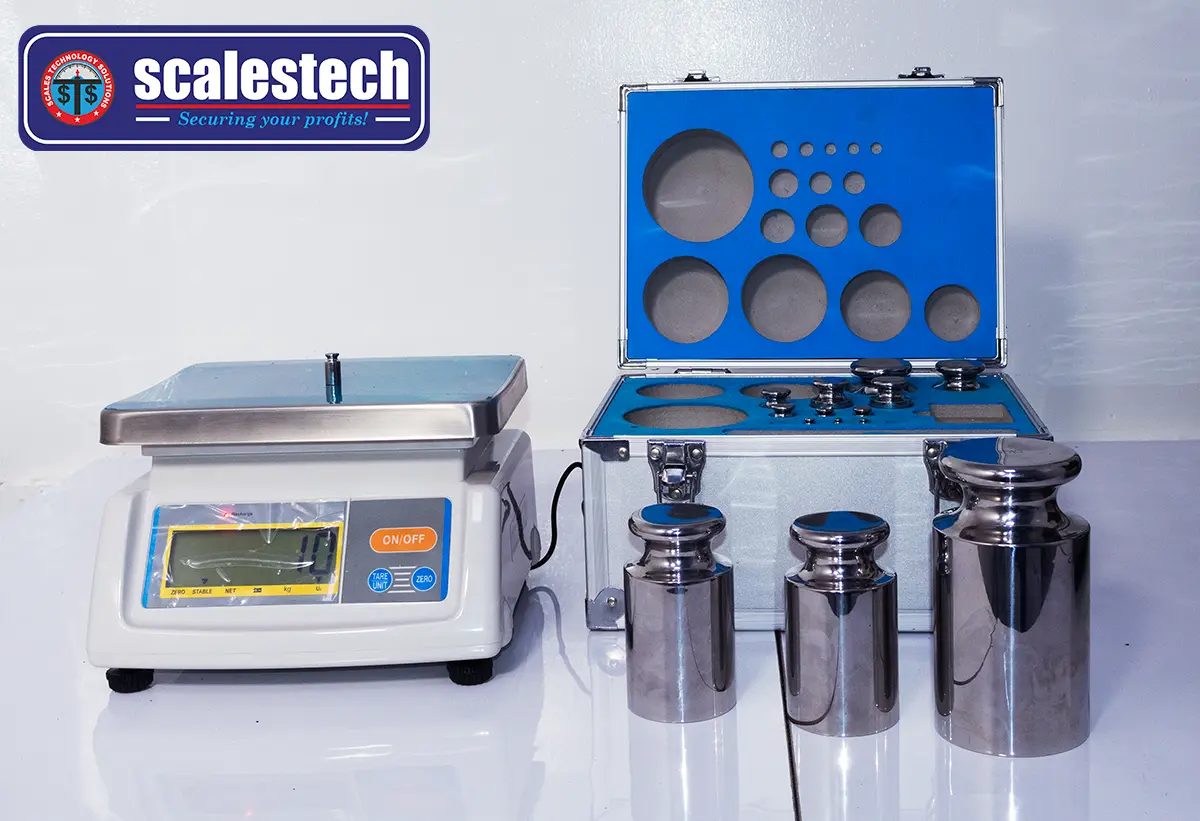
How to check calibration of a digital weighing scale yourself
Between professional calibrations, you can do a quick daily check: make sure the scale reads zero when empty, then place a known standard mass on the centre of the platform. If the reading differs by more than the scale's stated accuracy, stop using it for trade and book a calibration. Avoid using random objects such as bags of sugar as check weights; their weight is not certified.
How often should you calibrate?
| Use | Suggested interval |
|---|---|
| Retail and counter scales | Every 12 months, before annual stamping |
| Industrial floor and platform scales in heavy use | Every 6–12 months |
| Laboratory and analytical balances | Every 6–12 months, with routine user checks |
| Weighbridges | Every 6–12 months, and after any structural repair |
| After a repair, relocation or overload | Immediately |
Traceability: why accreditation matters
Traceability means your scale's readings can be linked, through an unbroken chain of calibrations, to national and international standards of mass. Our reference weights are calibrated against national standards, which are in turn linked to the International System of Units (SI). Since 2019 the kilogram has been defined by a fixed physical constant (the Planck constant) rather than a physical object, but the chain of traceability works the same way.
Because our lab is ISO/IEC 17025 accredited by KENAS, our methods and uncertainty calculations are independently audited, and our certificates are accepted by auditors and regulators.
What a calibration certificate should show
- Scale make, model, serial number, capacity and location
- Reference weights used and their traceability
- Test results at each load point and the errors found
- Measurement uncertainty
- Date, technician and the accreditation mark of the lab
Calibration vs stamping
Calibration is a technical check that produces a certificate. Stamping (verification) is the legal approval of a trade scale by the Weights & Measures Department. Most trade scales need both. See maintenance, calibration and stamping explained.
Frequently asked questions
It is the process of comparing a scale’s readings with certified reference weights, recording the errors and adjusting the scale so it reads within tolerance.
At least once a year for most scales, and every 6 months for heavily used industrial scales, laboratory balances and weighbridges. Always recalibrate after a repair, move or overload.
You can check it daily with a certified test weight. Adjusting a trade or audited scale should be done by a competent calibration provider with traceable weights, and trade scales must then be verified by Weights & Measures.
It means a calibration laboratory’s competence, methods and measurement uncertainty have been independently assessed. Scalestech’s lab is accredited by KENAS, the Kenya Accreditation Service.
Yes. Our team calibrates weighbridges, floor scales and platform scales on site across Kenya. Book a calibration.
Need a traceable calibration certificate? See our KENAS-accredited calibration services or book a calibration.
Video: Legal metrology explained: what every business needs to know
How legal metrology links calibration, verification and fair trade. Request a quote or watch more on our YouTube channel.
Related from Scalestech
See industrial scales, retail scales and our calibration and repair services, or request a quote.