RwandAir Smart Baggage Scale Case Study: Self-Service Check-In for African Aviation
RwandAir didn't just want a bigger scale — they wanted a self-service airport baggage scale that could do the job of a check-in agent: weigh the bag, confirm it meets the airline's size limits, and tell the passenger in real time whether they're good to fly. It had to be fast, accurate, and require zero staff supervision.
Scalestech designed, built, and deployed exactly that: a smart baggage scale with voice guidance, an integrated cabin-bag sizer, and overload protection. This case study covers how the scale works, the technology inside it, and the results RwandAir has seen since deployment — followed by a full breakdown of the Airport Self-Check-In Baggage Scale as a standalone product for any airline, airport authority, or travel operator in Kenya and East Africa.
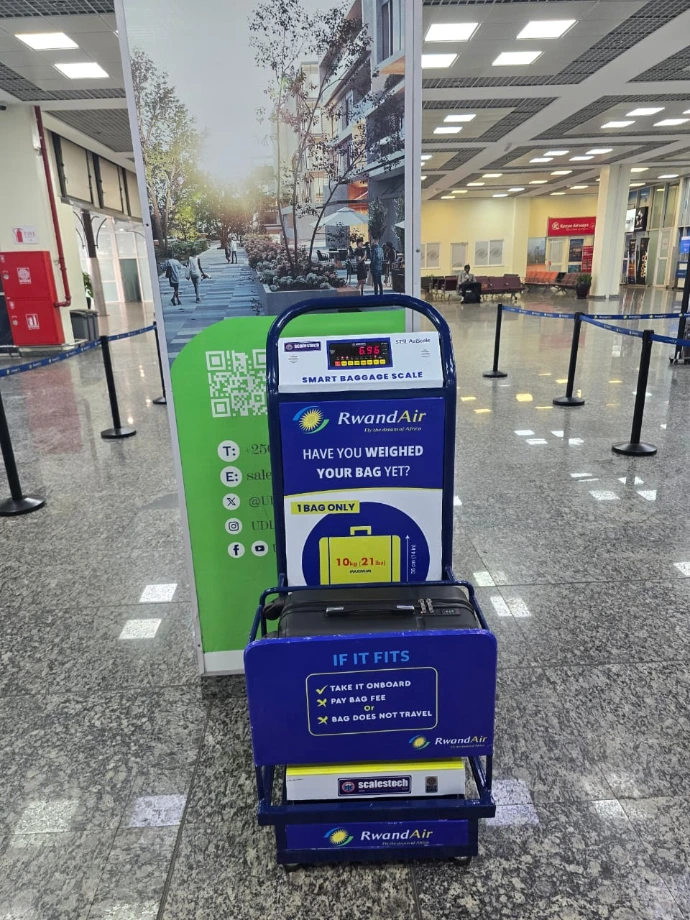
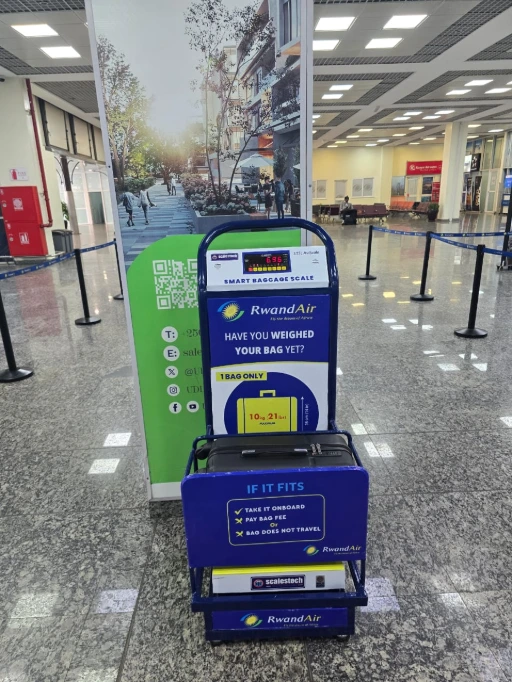
The Challenge: Manual Baggage Weighing Was Slowing Down RwandAir's Check-In Counters
Every airline check-in counter runs on a simple rule: cabin baggage has a weight limit and a size limit, and both have to be enforced consistently, bag after bag, for hours at a stretch. Done manually, that means a staff member lifting each bag onto a scale, reading the display, cross-checking it against a printed policy, and then explaining the result to the passenger — sometimes several times an hour when the answer is “your bag is over the limit.”
At the volumes RwandAir was handling, that process created two compounding problems. First, queues built up at peak travel times, particularly on routes connecting through Kigali to other African, Middle Eastern, and European hubs. Second, staff time that could have gone into higher-value passenger service was instead spent on repetitive, low-value weighing and explaining. RwandAir needed a way to take the routine part of that job — the weigh, the size check, the explanation — and hand it to the equipment itself, without losing accuracy or consistency.
The Brief: A Self-Service Scale Built for High-Traffic Airports
The brief Scalestech worked from was specific. The unit had to weigh accurately and instantly. It had to physically verify cabin bag dimensions, not just weight, since oversized-but-light bags are just as much of a problem at the gate as overweight ones. It had to communicate the result to the passenger directly, without requiring an agent to interpret the display. And it had to survive constant use in a high-traffic terminal environment — durable enough for daily handling, portable enough to reposition between counters or peak-hour overflow points, and reliable enough to run unattended for long stretches.
The Solution: A Smart Baggage Scale With Voice Guidance
Scalestech's answer was a self-service baggage validation station, not just a digital scale. A passenger wheels their bag onto the platform; within under 2 seconds the unit measures both weight and dimensions, checks the result against RwandAir's preset limits, and tells the passenger — by voice and on-screen — whether the bag is good to fly.
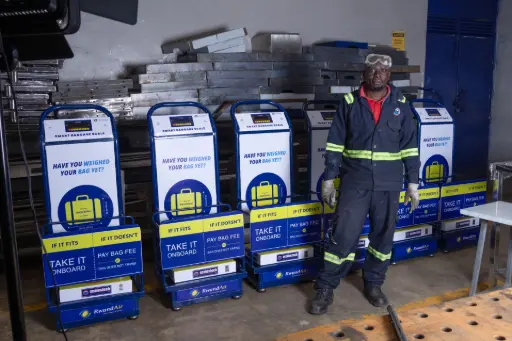
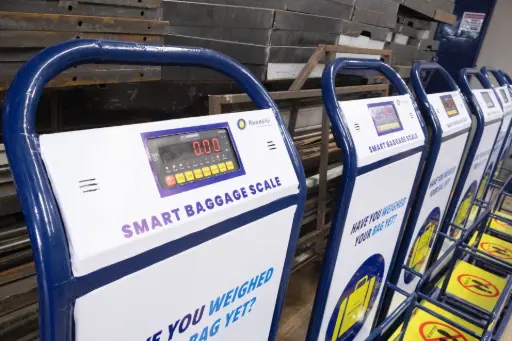
Audio Feedback That Removes the Need for a Check-In Agent
The centrepiece of the build is integrated audio feedback. The instant a bag lands on the platform, the scale speaks: either confirming the bag is compliant and the passenger can proceed, or flagging that the bag needs to be checked or repacked. Because the instruction comes from the equipment itself, in plain language, passengers act on it immediately — there's no waiting for a staff member to read the number, interpret it against policy, and relay it back. That single feature is what cuts the most time out of the check-in queue, and it's also what makes the unit genuinely self-service rather than just self-weighing.
LP7510 Digital Indicator: Built for Low-Light Terminal Visibility
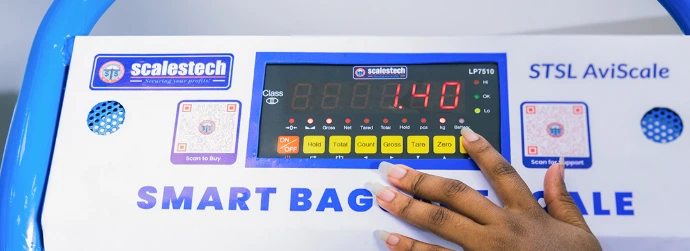
The scale runs on Scalestech's LP7510 indicator, a high-performance digital display built specifically for environments like airport terminals where lighting varies and readability can't be compromised. Its 6-digit LED screen uses large 20mm characters, so the reading is clearly visible even at night or in dim check-in areas. On the connectivity side, it comes with an RS232 port for data transmission as standard, with optional RS485 and USB connections available if an airport wants to feed the reading into a larger check-in or kiosk system. Power is flexible too: the indicator runs on either AC mains or a rechargeable battery, so it isn't tied to a fixed power point and can be repositioned as terminal layouts change.
Integrated Dimension Sizer Cage (56 x 36 x 23cm)
Weight is only half the compliance problem — size is the other half, and it's the one manual processes tend to enforce inconsistently, since it depends on a staff member's judgement rather than a fixed measurement. Scalestech built a physical dimension sizer cage into the unit, set at 56 x 36 x 23cm, matching the cabin bag allowance most East African carriers enforce. Passengers can see for themselves whether their bag fits, which removes the ambiguity — and the friction — that comes with a staff member telling them their bag “looks” oversized.
Overload Protection up to 150kg
Because the unit runs unattended for long periods, it has to survive passengers occasionally placing far more than a cabin bag on the platform. The scale is rated with overload protection up to 150kg, well beyond any realistic cabin bag weight, so a mis-loaded item doesn't damage the load cell or take the unit out of service mid-shift.
Portable, Wheeled Design for Fast Redeployment
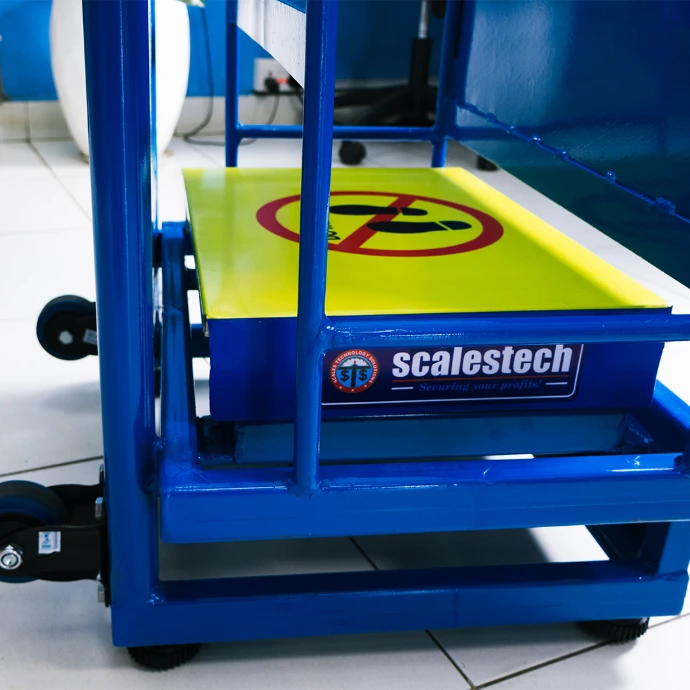
Airport traffic isn't static — check-in demand shifts by flight schedule, time of day, and season. Scalestech built the entire unit to be portable as well as durable: it sits on wheels with a tilt-handle, so ground staff can move it between check-in zones or bring in extra units during peak periods without needing a maintenance crew to relocate fixed equipment.
Results: What RwandAir Achieved After Deployment
Since the Smart Baggage Scale went live in RwandAir's check-in environment, the airline has seen measurable operational improvement:
Passenger check-in time reduced significantly, driven almost entirely by removing the manual weigh-and-explain step
Lower staff workload during peak check-in periods, freeing agents to handle exceptions and higher-value passenger service
More consistent enforcement of weight and size policy, since the sizer cage and scale apply the same standard to every bag
Higher passenger satisfaction at the first point of contact, with fewer disputes over subjective size or weight judgement calls
What Scalestech delivered for RwandAir is more than a piece of check-in equipment — it's a practical fix for one of the most repetitive friction points in the airport passenger journey. And the same solution applies well beyond one airline: airports, bus terminals, and any high-traffic environment where baggage has to be weighed and verified at scale.
Airport Self-Check-In Baggage Scale: Full Product Overview
Outside of the RwandAir deployment, Scalestech supplies the same Airport Self-Check-In Baggage Scale as a standalone product to airports, airlines, ground handlers, and travel operators across Kenya and East Africa. Here's how it works and what it includes.
How the Self-Check-In Baggage Scale Works
A passenger wheels their carry-on onto the platform. In under 2 seconds, the unit measures weight and checks it against the sizer cage dimensions, then gives an immediate voice and display response: “Weight is OK — please proceed,” or “Over limit — please check your bag.” That real-time feedback loop is what removes the need for staff supervision at the weigh point — the traveller gets a clear answer directly from the equipment and can act on it themselves, without a manual inspection queue forming behind them.
Key Features at a Glance
Voice guidance that instantly tells travellers whether their bag is good to fly
Integrated sizer cage (56 x 36 x 23cm) enforcing a consistent “if it fits, it flies” policy
50kg weighing capacity at 0.1kg increments, with overload protection up to 150kg
Fast, stable readings in under 2 seconds
Portable design with wheels and a tilt-handle for easy repositioning between counters or terminals
Durable, tamper-proof construction built for constant daily use in high-traffic environments
Auto-zero, tare, hold, standby and low-battery alert functions
Optional RS485/USB connectivity for integration into airport kiosk or check-in systems
Specifications
Feature | Specification |
|---|---|
Max weight | 50kg (0.1kg accuracy) |
Overload protection | Up to 150kg |
Sizer dimensions | 56 x 36 x 23cm |
Power | 6V 4.5Ah rechargeable battery, or 9V 1A AC adapter |
Display | 6-digit LED/LCD, 20mm characters |
Connectivity | RS232 standard; RS485/USB optional |
Response time | Under 2 seconds for a stable reading |
Functions | Auto-zero, tare, hold, standby, low-battery alert |
Mobility | Wheeled base with tilt-handle |
Build | Weather-resistant, tamper-proof sensors |
Where This Scale Can be Used Across East African Aviation
The same self-check-in platform scales across several high-traffic environments beyond a single airline counter:
Airports – JKIA, Mombasa, Kigali, Entebbe, Dar es Salaam
East Africa's busiest hubs — Jomo Kenyatta International Airport (JKIA) in Nairobi, Moi International Airport in Mombasa, Kigali International Airport, Entebbe International Airport, and Julius Nyerere International Airport in Dar es Salaam — all run the same check-in dynamic RwandAir faced: rising passenger volumes, cabin bag weight and size limits that vary slightly by carrier, and a manual weighing process that scales poorly during peak periods. Most East African carriers keep cabin baggage limits in a fairly narrow band, typically in the region of 7kg to 12kg depending on the airline and fare class, with maximum dimensions commonly around 55 x 35-38 x 22-25cm — close enough across carriers that a single self-check-in scale, configured to the specific airline's limits, comfortably covers the policy. A self-service scale at these counters reduces queue build-up during the morning and evening peak banks that most East African hub airports run on, without requiring additional check-in staff.
Airlines & Security Pre-Screening
Airlines and ground-handling agents can deploy the same unit at pre-boarding or security pre-screening points, catching non-compliant cabin bags before they reach the gate rather than after, which is where disputes and last-minute repacking cause the most delay.
Bus Terminals & Travel Agencies
The same weighing and sizing logic applies directly to East Africa's long-haul bus terminals — routes like Nairobi to Kampala, Mombasa to Dar es Salaam, or Nairobi to Kigali — where operators increasingly enforce baggage limits but still do it manually at the counter. Travel agencies handling group bookings can use a portable unit for pre-departure baggage checks, avoiding disputes at the terminal itself.
The Business Case: What Self-Check-In Weighing Actually Saves
For an airport or airline evaluating this as a purchase rather than reading it as a case study, the return sits in three places. The first is staff time: every bag that's weighed, sized, and cleared by the unit itself is a bag an agent didn't have to individually inspect, which adds up quickly across a full day of check-in banks. The second is queue throughput — shorter, more predictable weighing time per passenger means counters clear faster during the morning and evening peaks that most East African hub airports run on, which reduces knock-on delays elsewhere in the check-in process. The third, harder to put a number on but just as real, is passenger experience: a traveller who gets a clear, immediate, non-judgemental “your bag is fine” or “please repack” from a machine tends to have a smoother interaction than one who has to negotiate a subjective call with a rushed staff member. None of these require assumptions about cost — they're operational effects that show up in queue length and staff rostering within weeks of deployment, which is part of why RwandAir's result was measurable quickly rather than only over a long observation period.
Built for East African Terminal Conditions, Not Just Imported
A detail worth pulling out on its own: a lot of airport weighing equipment sold into East Africa is designed for climates and power conditions that don't match the region. Terminals here deal with heat, dust, humidity swings between coastal and highland cities, and power supply that isn't always as consistent as a manufacturer's spec sheet assumes. The Smart Baggage Scale's dual power option — AC mains or rechargeable battery — exists specifically so a power interruption doesn't take the unit offline mid-shift, and the weather-resistant, tamper-proof build is a direct response to the wear a unit sees in a high-traffic public terminal rather than a controlled lab environment. That's a meaningful difference between buying equipment off a catalogue and buying equipment from a supplier that installs and services it on the ground in Nairobi, Mombasa, Kigali, and beyond.